Explore how digital marketing evolved from 2007 to 2026, including major shifts, strategic lessons, AI advancements, and insights from 17 years of real industry experience.
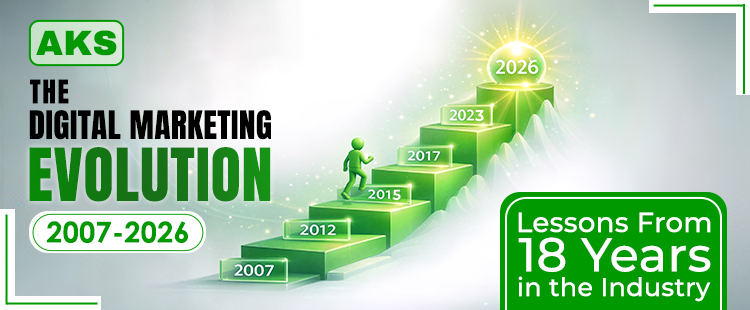
The Digital Marketing Evolution (2007–2026): Lessons From 17 Years in the Industry
Introduction — Setting Context
When I started my career in digital marketing back in 2007, the iPhone had just launched and most businesses were still figuring out this whole “internet thing.” Social media was in its infancy, Google was a simpler search engine, and the idea of AI creating content would have sounded like science fiction.
Looking back now, what strikes me most isn’t just how much has changed—it’s how the core principles of good marketing have remained constant while the tools and tactics have shifted dramatically. We’ve moved from keyword stuffing to user experience optimization, from link farms to topical authority, and now we’re entering an era where artificial intelligence is reshaping everything we thought we knew.
The businesses that have thrived through these changes aren’t necessarily the ones that jumped on every new trend. They’re the ones that understood which fundamentals to hold onto while adapting their methods. For today’s business leaders, understanding this evolution isn’t just about marketing history—it’s about recognizing patterns that will help you navigate whatever comes next.
The speed of change in digital marketing can feel overwhelming, but there’s comfort in knowing that beneath all the surface-level shifts, successful marketing still comes down to building trust, providing value, and meeting people where they are.
The First Era (2007–2012): SEO, Content & Link Building
In the early days, digital marketing felt like a treasure hunt where X marked the spot on Google’s first page. The formula was straightforward: find keywords people were searching for, create content around those keywords, and get as many websites as possible to link back to yours.
I remember spending hours submitting articles to directories like EzineArticles and building links through blog networks. The goal was simple visibility. If you could rank on the first page of Google, traffic would follow. Quality mattered less than quantity, and many of us built websites that were more for search engines than for actual humans.
Businesses during this time were just beginning to understand that having a website wasn’t enough—they needed to be found. The companies that got ahead early were the ones that embraced blogging, understood basic SEO principles, and weren’t afraid to invest time in creating content consistently.
The tools were basic but effective. WordPress was becoming the go-to platform, Google Analytics was free and revolutionary, and social media platforms like Facebook and Twitter were starting to show their potential for driving traffic.
What worked then:
- Heavy keyword optimization in titles and content
- Building links through article submissions and directory listings
- Creating lots of content around popular search terms
- Basic on-page SEO like meta descriptions and header tags
Key lesson from this era: Digital marketing was a visibility game
The businesses that showed up consistently and understood basic SEO principles had a significant advantage. It wasn’t about being perfect—it was about being present and persistent.
The Second Era (2013–2017): User Experience & Mobile-First
Everything changed when Google decided that user satisfaction mattered more than keyword density. The Panda update in 2011 had started this shift, but by 2013, it was clear that the old playbook wasn’t working anymore. Websites with thin content and manipulative linking strategies were getting penalized hard.
The Penguin update targeted link schemes, Hummingbird made Google better at understanding natural language, and suddenly we had to think like users instead of search engines. This was also when mobile usage started exploding, forcing every business to reconsider their website design and user experience.
I watched many businesses struggle during this transition because they had built their entire digital presence around gaming the system rather than serving their customers. The companies that adapted quickly were the ones that had always prioritized their users’ experience, even when the algorithms didn’t reward it.
This era taught us that Google was getting smarter about measuring user behavior signals. Bounce rates, time on page, and click-through rates became more important than keyword density. The focus shifted from getting traffic to keeping that traffic engaged.
Mobile-first design wasn’t just a nice-to-have anymore—it became essential. Businesses that didn’t optimize for mobile found themselves losing both users and rankings as Google implemented mobile-first indexing.
What became important:
- Page loading speed and technical performance
- Mobile-responsive design and user experience
- Content quality over quantity
- Natural language and user-focused writing
- Engagement metrics and user behavior signals
Key lesson from this era: User behavior became the new algorithm
Google got better at measuring whether people actually found value in your content, and businesses had to shift from trying to trick the system to actually serving their audience well.
The Third Era (2018–2023): Branding, Topical Authority & SERP Experience
The last few years have been about proving you deserve to rank, not just optimizing to rank. Google’s E-E-A-T guidelines (Experience, Expertise, Authoritativeness, Trustworthiness) became the new standard, especially for businesses in health, finance, and other industries where accuracy matters.
Content clustering and topical authority became major strategies. Instead of targeting individual keywords, successful businesses started building comprehensive resource hubs around entire topics. They demonstrated expertise through depth of coverage rather than breadth of keywords.
Local SEO exploded during this period, particularly as mobile search grew and businesses realized that “near me” searches were often more valuable than broad national terms. Online reviews and reputation management became crucial ranking factors, not just for local businesses but for all companies trying to build trust online.
Social proof started influencing search results directly. Google began showing review stars in search results, and businesses with strong online reputations found themselves with competitive advantages that went beyond traditional SEO.
The rise of featured snippets, knowledge panels, and other SERP features meant that ranking #1 wasn’t always the goal anymore. Sometimes position zero or a well-optimized knowledge panel could drive more traffic than the top organic result.
During this period, I noticed that businesses with strong brand recognition and consistent messaging across all platforms performed better in search results. It wasn’t enough to be technically optimized—you needed to be recognizable and trusted.
What defined success:
- Building topic clusters and comprehensive content hubs
- Establishing clear expertise and authority in specific niches
- Managing online reputation and encouraging customer reviews
- Creating consistent brand experiences across all touchpoints
- Optimizing for various SERP features beyond traditional rankings
Key lesson from this era: Authority replaced shortcuts.
The businesses that invested in becoming genuine experts in their fields, building real relationships with customers, and establishing strong online reputations saw the most sustainable growth.
The AI & Predictive Era (2024–2026): Intelligence + Creativity + Systems
We’re now entering what might be the most transformative period in digital marketing history. ChatGPT and other AI tools have changed not just how we create content, but how people search for and consume information. The traditional Google search is being supplemented by conversational AI, and businesses need to adapt their strategies accordingly.
AI can now generate content faster than any human team, but the businesses that are winning aren’t just using AI to create more content—they’re using it to create better systems for understanding their customers, personalizing experiences, and making data-driven decisions.
Search behavior is shifting as people become comfortable asking AI assistants complex questions instead of typing keywords into search boxes. This means businesses need to optimize for conversational queries and provide comprehensive, authoritative answers rather than quick keyword matches.
The most successful companies I’m working with now use AI as a multiplier for human insight rather than a replacement. They’re using predictive analytics to understand customer behavior, AI tools to personalize marketing messages, and automation to handle routine tasks while their human teams focus on strategy and relationship building.
Performance tracking has become more sophisticated, with businesses able to predict customer lifetime value, identify at-risk customers, and personalize marketing touchpoints in real-time. But this level of sophistication only works when you have clear systems and processes in place.
What’s working now:
- AI-assisted content creation guided by clear strategic direction
- Conversational optimization for AI search results
- Predictive analytics for customer behavior and lifetime value
- Automated personalization based on user behavior patterns
- System-driven approaches to marketing operations and measurement
Key lesson for this era: AI is a multiplier for those who already have clarity
The businesses that understand their customers, have clear messaging, and operate with good systems are seeing AI accelerate their results. Those without these fundamentals find that AI just helps them create more confusion, faster.
17 Years of Strategic Learning — The Principles That Don’t Change
After watching the industry evolve through four distinct eras, certain principles have remained constant despite all the technological changes. These have become the foundation of my approach to marketing strategy:
Marketing is about trust, not tactics
Every successful campaign I’ve been part of ultimately came down to building trust with the audience. Whether it was through consistent content in 2010 or authentic social proof in 2020, the tactics changed but the need for trust never did. Businesses that focus on short-term tricks might see temporary gains, but sustainable growth always comes from genuine relationship building.
Strategy before execution
The companies that thrived through multiple algorithm changes and platform shifts were the ones with clear strategies that could adapt to new tactics. Having a deep understanding of your customer, your value proposition, and your business goals creates a foundation that remains stable even when the execution methods change completely.
Consistency creates authority
Whether we’re talking about publishing blog posts in 2008, maintaining social media presence in 2015, or optimizing for AI search in 2024, consistency has always been the secret ingredient. The businesses that show up regularly, provide value consistently, and maintain their presence through both good times and challenging periods are the ones that build lasting authority in their industries.
Data informs, but human insight decides
Every era has brought new data and measurement capabilities, but the most successful marketers I know use data to inform their decisions, not make them. Numbers can tell you what’s happening, but understanding why it’s happening and what to do about it requires human insight, experience, and intuition.
Growth is repeatable when systems exist
The businesses that have scaled successfully through multiple changes in the digital landscape are the ones that built systems for their marketing operations. Whether it’s content creation, customer acquisition, or performance measurement, having repeatable processes allows you to adapt quickly when the tools or platforms change.
These principles have guided every successful campaign, every major strategic shift, and every client relationship that has produced lasting results. They’re not flashy or exciting, but they’re reliable in a way that individual tactics never can be.
The Role of Leadership in Marketing Success
Looking back on 17 years in this industry, the biggest factor in marketing success isn’t the tactics, tools, or even the budget—it’s leadership. The businesses that have consistently performed well have leaders who understand their role in shaping marketing outcomes.
Successful marketing leaders create a culture of learning within their organizations. They encourage experimentation while maintaining focus on core objectives. They invest in standard operating procedures that allow their teams to execute consistently while adapting to new opportunities.
The founders and CMOs who get the best results are the ones who understand that marketing isn’t just a department—it’s a business function that touches every aspect of how customers experience their company. They align their teams around customer value rather than internal metrics.
Accountability becomes crucial when you’re trying to build something sustainable. The leaders who see long-term success are the ones who measure what matters, communicate results clearly, and make decisions based on data rather than assumptions or preferences.
But perhaps most importantly, the right leadership mindset treats marketing as an investment in relationships rather than an expense for transactions. This perspective shapes every decision, from budget allocation to campaign strategy, and it’s often the difference between businesses that grow sustainably and those that struggle with constant customer acquisition challenges.
The marketing landscape will continue to change, but businesses with strong leadership that understands these fundamentals will always have an advantage. They’ll adapt faster, make better decisions, and build more resilient growth systems.
Closing — Your Vision for 2026 and Beyond
As we move deeper into the AI era, I see digital marketing becoming more strategic and less tactical. The businesses that will thrive are the ones that use technology to better understand and serve their customers rather than just reach more of them.
By 2026, I expect we’ll see AI handling most routine marketing tasks—content creation, ad optimization, basic customer service, and performance reporting. This means human marketers will need to focus on the things AI can’t do: strategic thinking, creative problem-solving, relationship building, and understanding the deeper motivations that drive customer behavior.
The opportunity right now is enormous for businesses that start adapting early. While others are still trying to figure out how AI fits into their current processes, forward-thinking companies are rebuilding their marketing operations around AI-enhanced systems. They’re getting comfortable with conversational search optimization, predictive customer analytics, and automated personalization.
The next chapter of digital marketing will belong to businesses that combine technological capability with genuine human insight. AI will handle the execution, but success will still depend on understanding your customers, creating real value, and building trust over time.
For founders, marketers, and entrepreneurs who want to stay ahead of these changes, the key is to focus on building strong foundations now—clear positioning, deep customer understanding, and systematic approaches to growth—while experimenting with new tools and capabilities as they emerge.
The businesses that master this balance will find themselves with sustainable competitive advantages that compound over time. The next few years will be defining for many companies, and those who approach this transition thoughtfully will likely dominate their markets for the decade to come.
The evolution continues, and the most exciting developments are still ahead of us.
Frequently Asked Questions
Q: How can small businesses compete with larger companies that have bigger AI budgets?
A: Small businesses actually have an advantage in the AI era because they can move faster and be more personal. While large companies struggle with bureaucracy and broad messaging, small businesses can use AI tools to create highly personalized content and experiences for their specific audience. The key is focusing on your niche expertise and using AI to amplify your unique value rather than trying to compete on scale. Many AI tools are now affordable or even free, so budget isn’t the main barrier—clarity of purpose and customer understanding are.
Q: What should businesses prioritize if they’re just starting their digital marketing journey in 2025?
A: Start with the fundamentals that haven’t changed: understand your customer deeply, create a clear value proposition, and build systems for consistent execution. Then layer in modern tools like AI-assisted content creation and conversational search optimization. Don’t skip the foundation to chase the latest trends. The businesses succeeding now are the ones that combine solid strategic thinking with smart use of new technology, not those that rely purely on AI or other tools to solve unclear positioning or messaging problems.
Q: How will traditional SEO change as AI search becomes more common?
A: SEO is evolving from keyword optimization to conversation optimization. Instead of targeting specific keywords, focus on providing comprehensive, authoritative answers to the questions your customers actually ask. This means creating content that works well for both traditional search and AI assistants. The fundamentals of good SEO—helpful content, fast-loading websites, good user experience—remain important, but you’ll need to think more about how AI will interpret and present your content to users.
Q: Is it worth investing in building topical authority, or should businesses focus entirely on AI optimization?
A: Topical authority is more important than ever because AI systems rely on authoritative sources for their responses. When ChatGPT or other AI tools answer questions in your industry, they’re more likely to reference and recommend businesses that have demonstrated expertise through comprehensive content and strong online reputations. Building topical authority and AI optimization aren’t competing strategies—they work together. AI can help you create more content around your expertise areas, but you still need to prove you’re worth referencing.
Q: What’s the biggest mistake businesses make when trying to adapt to the current AI-driven marketing landscape?
A: The biggest mistake is using AI as a shortcut instead of a multiplier. Many businesses think they can use ChatGPT to create their entire content strategy without having clear messaging, customer understanding, or business goals. This leads to generic content that doesn’t connect with anyone. The most successful businesses use AI to execute their existing strategy faster and more efficiently, not to replace strategic thinking. If you don’t know what you’re trying to achieve or who you’re trying to reach, AI will just help you create confusion more quickly.